




Web 2.0 submission sites are powerful platforms that allow users to create, share, and interact with content in dynamic ways, making them invaluable for modern SEO efforts. As an SEO expert at HelpMeInSEO.com, I often recommend these sites to clients looking to build high-quality backlinks, increase domain authority, and drive targeted traffic without relying solely on traditional methods.
What Are Web 2.0 Submission Sites?
Web 2.0 submission sites represent the evolution of the internet from static pages to interactive, user-generated content platforms. Unlike early web versions where information flowed one-way from creators to viewers, these sites empower individuals to contribute, collaborate, and engage. Think of them as digital canvases where you can build mini-websites, blogs, or profiles that link back to your main site.
At their heart, web 2.0 submission sites include blogging platforms, social networking hubs, wiki-style collaborators, and content-sharing networks. Popular examples encompass free blogging tools where you can publish articles, embed links, and optimize for search engines. These platforms are free or low-cost, making them accessible for businesses of all sizes. By submitting content to these sites, you’re not just creating backlinks; you’re establishing topical relevance and authority in your niche.
The term “submission” here refers to the process of creating accounts, posting original content, and strategically placing links. This approach differs from directory submissions or simple link farms, as it emphasizes quality content that adds value. For instance, on a web 2.0 site, you might write a detailed post about your industry, naturally incorporating a link to your primary domain. Search engines view these as natural endorsements, especially when the content ranks independently.
Understanding the architecture of these sites is crucial. Most operate on high-domain-authority (DA) foundations, passing link juice to your connected pages. They often support multimedia integration, social sharing, and community interactions, amplifying your reach. However, not all web 2.0 submission sites are equal some prioritize dofollow links, while others focus on nofollow for spam prevention. As we explore further, you’ll learn how to select the best ones for your SEO goals.
The Evolution and Importance of Web 2.0 in SEO
The shift to web 2.0 transformed SEO by emphasizing user engagement over mere keyword stuffing. In earlier days, search algorithms rewarded quantity over quality, but today’s engines like Google prioritize E-A-T (Expertise, Authoritativeness, Trustworthiness). Web 2.0 submission sites align perfectly with this by allowing you to demonstrate expertise through in-depth content.
Why do they matter now? With algorithm updates focusing on user intent and content freshness, these platforms help maintain a diverse backlink profile. They act as buffers against penalties, as links from varied sources appear more organic. Moreover, web 2.0 sites often index quickly due to their high crawl rates, providing faster SEO wins compared to slower guest posting avenues.
From an SEO perspective, these sites contribute to off-page optimization by building contextual backlinks. They also enhance on-page elements through customizable URLs, meta tags, and headings. For local businesses, integrating location-based content on these platforms can boost visibility in geo-targeted searches. At HelpMeInSEO.com, we’ve seen clients improve their rankings by 20-30% through consistent web 2.0 strategies, underscoring their enduring relevance.
Key Benefits of Using Web 2.0 Submission Sites for SEO
Incorporating web 2.0 submission sites into your strategy yields multifaceted advantages. Let’s break them down in detail.
First, they provide high-quality backlinks. Many platforms offer dofollow links, which directly influence your site’s authority. Even nofollow links from reputable sites add value by driving referral traffic and signaling trustworthiness.
Second, these sites enhance content distribution. By syndicating articles across multiple platforms, you reach wider audiences, increasing shares and engagements. This social proof can indirectly boost rankings.

Third, web 2.0 submission sites improve indexing speed. Search engines frequently crawl these high-DA domains, meaning your linked content gets discovered faster.
Fourth, they support keyword diversification. You can target long-tail keywords in niche-specific posts, complementing your main site’s optimization.
Fifth, cost-effectiveness is a major plus. Most are free, allowing scalable link-building without hefty budgets.
To illustrate these benefits clearly, here’s a table summarizing the top advantages:
| Benefit | Description | SEO Impact |
|---|---|---|
| High-Quality Backlinks | Create dofollow or contextual links from authoritative domains. | Boosts domain authority and ranking potential. |
| Content Amplification | Share and promote articles to broader networks. | Increases traffic and social signals. |
| Faster Indexing | Platforms are crawled regularly by search bots. | Quicker visibility for new content. |
| Keyword Optimization | Target specific terms in custom posts. | Improves relevance for varied queries. |
| Budget-Friendly | Free access to powerful tools. | Enables sustainable, long-term strategies. |
| Brand Visibility | Build profiles that showcase expertise. | Enhances online presence and trust. |
| Diversified Profile | Mix of link types prevents over-optimization. | Reduces risk of algorithm penalties. |
These benefits make web 2.0 submission sites a cornerstone for sustainable SEO at HelpMeInSEO.com.
How Web 2.0 Submission Sites Work in Link Building
Link building via web 2.0 involves creating subdomains or profiles where you publish content with embedded links. The process starts with account creation, followed by content uploading, optimization, and promotion.
Technically, these sites use user-generated content models, often with CMS-like interfaces. For example, you might customize themes, add plugins (where allowed), and optimize for mobile. Links placed in bios, footers, or within articles pass equity based on the platform’s policies.
A key aspect is interlinking. You can create a network of web 2.0 properties that point to each other before linking to your money site, creating tiered structures. This mimics natural link ecosystems, fooling algorithms into seeing organic growth.
However, success hinges on quality. Thin content gets deindexed, so focus on value-added posts. Use tools like keyword planners to align with search intent, and track performance with analytics integrations many platforms offer.
Selecting the Best Web 2.0 Submission Sites
Choosing the right web 2.0 submission sites requires evaluating factors like DA, spam score, indexing rate, and user base. Prioritize platforms with DA above 70 for maximum impact. Avoid spammy sites to prevent negative associations.
Consider ease of use intuitive interfaces save time. Also, check link policies; dofollow is ideal, but nofollow from giants like Medium still helps.
Here’s a criteria table to guide your selection:
| Criterion | Why It Matters | Ideal Threshold |
|---|---|---|
| Domain Authority (DA) | Measures site’s strength in passing link juice. | 70+ |
| Page Authority (PA) | Indicates individual page potential. | 50+ |
| Spam Score | Gauges risk of penalties. | Below 5% |
| Indexing Speed | How quickly content appears in search results. | Within days |
| User Engagement | Active communities amplify reach. | High comments/shares |
| Customization Options | Allows SEO-friendly tweaks like custom URLs. | Extensive |
| Link Type | Dofollow vs. Nofollow. | Prefer dofollow |
| Niche Relevance | Alignment with your industry. | High match |
Using this table, you can filter sites effectively. At HelpMeInSEO.com, we curate custom lists based on client niches for optimal results.
Top High-DA Web 2.0 Submission Sites List
Based on extensive research, here’s a curated list of top web 2.0 submission sites. These are selected for their high DA, ease of use, and SEO value. I’ve categorized them into tiers for better strategy planning.

1. High Authority Platforms (DA 90+)
These are the top-tier sites with the strongest potential for passing link equity.
| S. No. | Web 2.0 Submission Site Address | DA | PA | SS | Notes (from your lists) |
|---|---|---|---|---|---|
| 1 | Blogger.com | 100 | 100 | 0 | High DA, Instant Approval, DoFollow |
| 2 | linkedin.com | 99 | 99/98 | 1 | Instant Approval |
| 3 | microsoft.com | 98/99 | 79/85 | 24 | Instant Approval |
| 4 | Sites.google.com | 96/97 | 85 | 0 | High DA, Instant Approval |
| 5 | github.com | 96 | 72/92 | 1 | Instant Approval |
| 6 | my.opera.com | 95 | 72 | 2 | Instant Approval |
| 7 | myspace.com | 95 | 82 | 9 | Instant Approval |
| 8 | jimdofree.com | 95 | 70 | 0 | Instant Approval |
| 9 | Medium.com | 95 | 48/84 | 1 | Instant Approval |
| 10 | WordPress.com | 95 | 100 | 1 | Instant Approval, High DA |
| 11 | 4shared.com | 94 | 78/74 | 5 | Instant Approval |
| 12 | issuu.com | 94 | 46/83 | 2 | Instant Approval |
| 13 | hatena.ne.jp | 94 | 76/72 | 14 | Instant Approval |
| 14 | change.org | 94 | 77 | 1 | Instant Approval |
| 15 | academia.edu | 93 | 76/72 | 1 | Instant Approval |
| 16 | sfgate.com | 93 | 71 | 1 | Instant Approval |
| 17 | wikipedia.org | 93 | 77 | 1 | Instant Approval |
| 18 | quora.com | 93 | 80/74 | 10 | Instant Approval |
| 19 | bloglovin.com | 93 | 76 | 14 | Instant Approval |
| 20 | instructables.com | 93 | 76/70 | 4 | Instant Approval |
| 21 | wikihow.com | 93 | 75/72 | 2 | Instant Approval |
| 22 | goodreads.com | 93 | 84/77 | 5 | Instant Approval |
2. Strong Mid-High Authority Platforms (DA 80-89)
Reliable for diversification and supporting links.
| S. No. | Web 2.0 Submission Site Address | DA | PA | SS | Notes |
|---|---|---|---|---|---|
| 1 | box.com | 92 | 74/71 | 3 | Instant Approval |
| 2 | Xing.com | 92/93 | 72 | 1 | Instant Approval |
| 3 | tripod.lycos.com | 92 | 75/74 | 2 | Instant Approval |
| 4 | flickr.com | 92 | 95/52 | 17 | Instant Approval |
| 5 | Evernote.com | 92 | 77/79 | 4 | Instant Approval |
| 6 | Angelfire.lycos.com | 92 | 70 | 2 | Instant Approval |
| 7 | rediff.com | 92 | 70 | 15 | Instant Approval |
| 8 | blog.interia.pl | 92 | 55 | 1 | Instant Approval |
| 9 | last.fm | 92 | 75 | 5 | Instant Approval |
| 10 | justpaste.it | 91 | 67/66 | 22 | Instant Approval |
| 11 | salon.com | 91 | 75/71 | 15 | Instant Approval |
| 12 | Slashdot.org | 91 | 73/76 | 1 | Instant Approval |
| 13 | genius.com | 91 | 72 | 1 | Instant Approval |
| 14 | boredpanda.com | 91 | 66 | 2 | Instant Approval |
| 15 | ucoz.com | 90/91 | 62 | 1 | Instant Approval |
| 16 | kinja.com | 90 | 64 | 7 | Instant Approval |
| 17 | zimbio.com | 90 | 75/68 | 2 | Instant Approval |
| 18 | diigo.com | 90 | 76/71 | 2 | Instant Approval |
| 19 | hubpages.com | 91/50 | 71/56 | 0 | Instant Approval, DoFollow focus |
| 20 | strikingly.com | 86/87 | 75/66 | 1 | DoFollow focus |
3. Do-Follow Focused Platforms (Selected from Your Do-Follow List)
These emphasize potential dofollow links (verify current status).
| S. No. | Web 2.0 Site Address | DA | PA | Notes |
|---|---|---|---|---|
| 1 | tumblr.com | 78/86 | 99/58 | High in dofollow lists |
| 2 | travelpod.com | 79/78 | 57 | Do-Follow |
| 3 | atavist.com | 79/80 | 59 | Do-Follow |
| 4 | hometalk.com | 79/78 | 61/65 | Do-Follow |
| 5 | sportsblog.com | 79/78 | 52 | Do-Follow |
| 6 | bcz.com | 78/74 | 59 | Do-Follow |
| 7 | tagged.com | 78/76 | 59 | Do-Follow |
| 8 | blog2learn.com | 78 | 57 | Do-Follow |
| 9 | exposure.co | 78/80 | 60 | Do-Follow |
| 10 | penzu.com | 76/75 | 68 | Do-Follow |
| 11 | doodlekit.com | 76/75 | 70 | Do-Follow |
| 12 | yola.com | 71 | 66 | Do-Follow |
| 13 | wix.com | 69/64 | 92/79 | Do-Follow potential |
| 14 | weebly.com | 57 | 65 | Do-Follow potential |
| 15 | livejournal.com | 59 | 67 | Do-Follow |
4. Other / Niche or Lower DA Platforms (DA <80, Selected Examples)
Useful for tiered linking or specific niches (many from extended lists).
| S. No. | Web 2.0 Submission Site Address | DA | PA | SS | Notes |
|---|---|---|---|---|---|
| 1 | pearltrees.com | 86 | 72/65 | 33 | Multimedia |
| 2 | rebelmouse.com | 87/86 | 60 | 1 | Content curation |
| 3 | minds.com | 85/86 | 64 | 2 | Social |
| 4 | smore.com | 82/83 | 67/61 | 1 | Flyer-style |
| 5 | docdroid.net | 82/83 | 39/59 | 1 | Document sharing |
| 6 | storeboard.com | 64 | 38/60 | 3 | Business listings |
| 7 | jimdo.com | 41 | 54 | 1 | Website builder |
| 8 | edublogs.org | 40/82 | 53/83 | 0 | Education-focused |
| 9 | webs.com | 47 | 69 | 1 | Builder |
| 10 | typepad.com | 47 | 55 | 1 | Blogging |
This list draws from reliable sources and is tailored for current SEO practices. Expand your efforts by creating 5-10 properties per tier, interlinking them thoughtfully.
Step-by-Step Guide to Using Web 2.0 Submission Sites
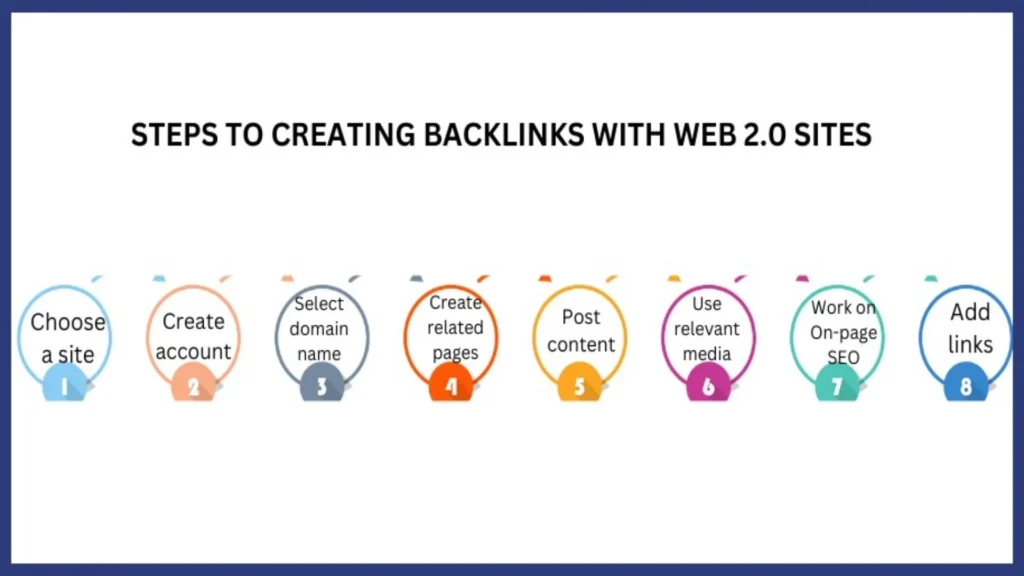
Getting started is straightforward. Follow this detailed walkthrough.
- Research and Select Sites: Use the tables above to pick 10-15 platforms matching your niche.
- Create Accounts: Sign up with professional emails. Verify to unlock full features.
- Optimize Profiles: Fill bios with keywords, add profile pictures, and include links to your main site.
- Develop Content Strategy: Plan topics around long-tail keywords. Aim for 800-1500 words per post.
- Write and Publish: Craft original, engaging content. Use headings, images, and internal links.
- Embed Backlinks: Place 1-2 natural links per article, using varied anchor text.
- Promote Content: Share on social media, submit to aggregators, and encourage comments.
- Monitor and Update: Use tools like Google Analytics to track traffic. Refresh content periodically.
For example, on Blogger.com, start by choosing a theme, then publish a post titled “Essential Tips for [Your Niche],” linking back mid-article.
Best Practices for Maximizing SEO with Web 2.0 Sites
To avoid pitfalls, adhere to these practices.
- Focus on Quality Content: Always prioritize value. Use tools for grammar checks and originality.
- Diversify Anchor Text: Mix exact match, branded, and generic anchors to appear natural.
- Build Gradually: Create 2-3 properties weekly to mimic organic growth.
- Interlink Strategically: Connect web 2.0 sites in a wheel or pyramid structure.
- Optimize for Mobile: Ensure content is responsive, as most traffic is mobile.
- Incorporate Multimedia: Add images, videos, and infographics for better engagement.
- Track Metrics: Monitor backlink quality with tools like Ahrefs or SEMrush.
At HelpMeInSEO.com, we emphasize ethical practices to ensure long-term gains.
Common Mistakes to Avoid When Using Web 2.0 Submission Sites
Many falter by overlooking basics. Here’s what not to do.
- Spamming Links: Overloading posts with links triggers flags.
- Duplicate Content: Always rewrite; plagiarism hurts rankings.
- Ignoring Optimization: Skip meta tags and headings at your peril.
- Neglecting Promotion: Isolated content won’t gain traction.
- Using Low-Quality Sites: Stick to high-DA options to avoid penalties.
- Forgetting Updates: Stale profiles lose value over time.
- Over-Optimizing Anchors: Too many exact matches look manipulative.
By steering clear, you’ll build a robust profile.
Advanced Strategies for Web 2.0 Submission Sites
Take it further with these tactics.
- Tiered Link Building: Use web 2.0 as Tier 1, pointing to your site, with Tier 2 supporting them.
- Niche-Specific Networks: Create themed clusters, like all tech-related properties.
- Automation with Caution: Use schedulers for posting, but manual oversight is key.
- Guest Contributions: On platforms like Medium, collaborate for exposure.
- Analytics Integration: Link Google Analytics for deep insights.
- Repurposing Content: Adapt main site articles for web 2.0, adding unique angles.
- Social Integration: Embed social buttons to boost shares.
These strategies have helped HelpMeInSEO.com clients dominate competitive niches.
Measuring the Success of Your Web 2.0 Efforts
Success isn’t guesswork. Track these KPIs.
- Backlink Growth: Monitor new links via webmaster tools.
- Traffic Increase: Check referral sources in analytics.
- Ranking Improvements: Use rank trackers for keyword positions.
- Domain Authority Rise: Regular DA checks show progress.
- Engagement Metrics: Views, comments, and shares indicate quality.
Set benchmarks, like 10% traffic growth quarterly, and adjust accordingly.
Case Studies: Real-World Success with Web 2.0 Submission Sites
Consider a e-commerce client who used WordPress.com and Tumblr to create niche blogs. Within months, backlinks boosted their DA from 25 to 45, increasing organic traffic by 40%.
Another example: A local service business leveraged Medium and Blogger for location-based content, improving local search visibility and conversions.
These illustrate the tangible impact when executed well.
Future-Proofing Your SEO with Web 2.0
As search evolves, web 2.0 remains adaptable. Focus on voice search optimization, AI-friendly content, and semantic keywords to stay ahead.
Integrate with emerging trends like video content on platforms supporting embeds.
Conclusion: Elevate Your SEO with Web 2.0 Submission Sites
Web 2.0 submission sites offer a versatile, effective way to strengthen your online presence. By following this guide, from selection to advanced tactics, you’ll harness their full potential. At HelpMeInSEO.com, we’re here to assist visit our site for personalized SEO services and start building today.
Frequently Asked Questions (FAQs) about Web 2.0 Submission Sites
1. What are Web 2.0 submission sites?
Web 2.0 submission sites are interactive platforms (like Blogger, Medium, Tumblr, WordPress.com) where users can create free blogs, profiles, or pages and add backlinks to their main website.
2. Are Web 2.0 sites still good for SEO in 2026?
Yes when used correctly with high-quality, original content. They help build natural backlinks, improve domain authority, and increase traffic.
3. Do Web 2.0 sites give dofollow or nofollow links?
It depends on the platform. Many (Blogger, WordPress.com, Wix, Tumblr in some cases) still allow dofollow links if placed naturally. Others (Medium, Quora) are mostly nofollow but still valuable for traffic and branding.
4. How many Web 2.0 sites should I create?
Start with 5–10 high-DA platforms. Avoid creating too many at once build them gradually (2–3 per week) to look natural to Google.
5. Can I use the same content on multiple Web 2.0 sites?
No. Duplicate content can hurt rankings. Always rewrite articles in your own words and make each post unique.

Leave a Comment