



GEO vs SEO — this isn’t just a marketing buzzphrase; it’s the strategic foundation for visibility in today’s evolving online landscape. Traditional SEO aimed to rank your website in search engine results pages (SERPs). But with the rise of AI-powered search platforms—like ChatGPT, Google SGE, Perplexity—Generative Engine Optimization (GEO) has emerged as a critical complement. This guide explores how SEO and GEO differ, where they overlap, and how to harness both for maximum exposure across search engines and AI answer engines.
1. What Is SEO?
Search Engine Optimization (SEO) refers to all the strategies you apply to make your web pages rank higher in search results on Google, Bing, and others. It focuses on:
- Content quality and relevance to search intent
- Technical aspects like site structure, mobile-friendliness, and speed
- On-page elements: titles, headings, meta descriptions, keyword optimization
- Off-page elements: backlinks, authority signals
- User experience and trust indicators
SEO continues to deliver the bulk of organic traffic—often with excellent ROI. For most businesses, it remains indispensable. However, the search ecosystem is shifting, and visibility is no longer limited to traditional SERPs.
2. What Is GEO?
Generative Engine Optimization (GEO), sometimes called GEO SEO or AI SEO, is about positioning your content to be not just findable—but citable—by AI-driven search systems (like ChatGPT or Google’s AI Overviews). Its focus is less on ranking, and more on being featured inside AI-generated answers as trusted sources.

GEO strategies include:
- Using structured data (schema markup), FAQs, prompt-style Q&A formatting
- Emphasizing content clarity, authoritative signals, and EEAT (Experience, Expertise, Authoritativeness, Trust)
- Optimizing for AI interpretability—so your content is parsed and surfaced accurately
3. SEO vs GEO: What’s the Difference?
| Aspect | SEO (Traditional) | GEO (Generative Engine) |
|---|---|---|
| Goal | Rank higher in SERPs and drive traffic | Be cited/referenced inside AI-generated answers |
| Primary Focus | Keywords, backlinks, rankings | Structure, clarity, EEAT, AI readability |
| Success Metric | Traffic, rankings | Citation in AI outputs, featured answers |
| Content Style | Optimized for search indexing | Optimized for direct AI interpretation |
| Technical Tools | Audits, backlink analysis, keyword research | Schema, FAQs, AI metadata, prompt-based layout |
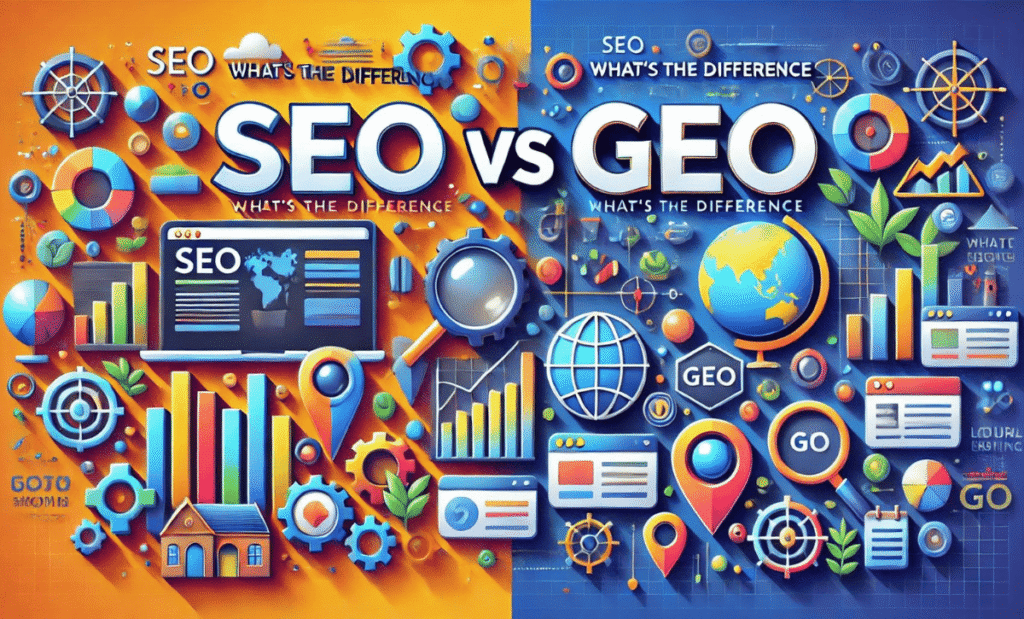
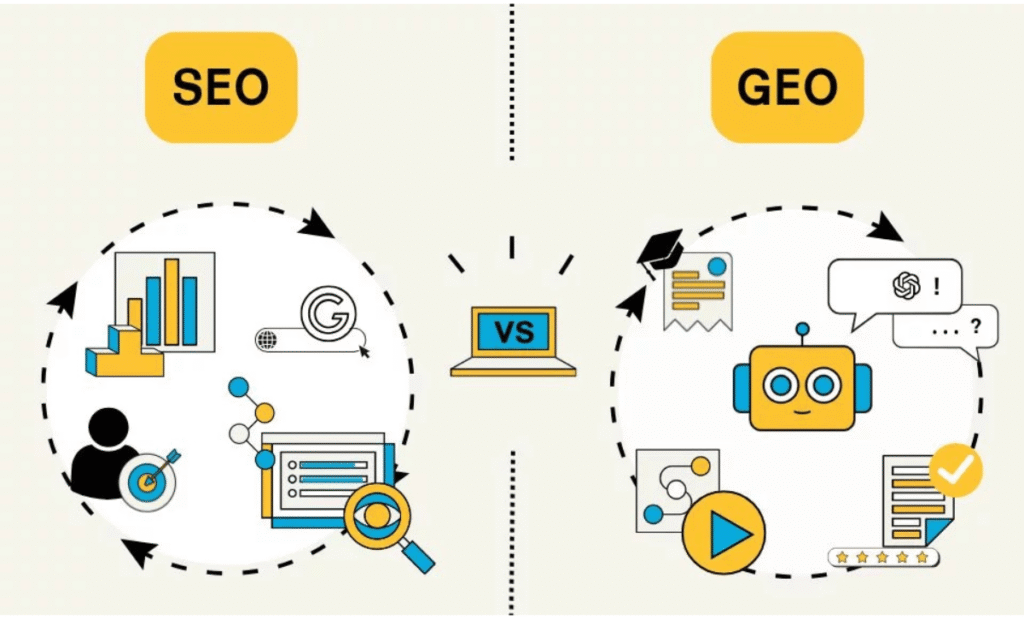
While SEO is about performing in search result lists, GEO is about being selected as an answer in AI-driven contexts—even without a click.
4. Where SEO and GEO Overlap
Despite different outcomes, SEO and GEO share foundational needs:
- User Intent: Both require in-depth understanding of what your audience wants. Matching intent drives both rankings and AI citations.
- Quality Content: Well-researched, helpful, and authoritative content resonates equally well with search algorithms and AI models.
- EEAT Importance: Trustworthy, expert-backed content is more likely to rank and be cited.
- Ongoing Optimization: Both SEO and GEO require updates—whether it’s adapting to algorithm changes or new AI citation models.
5. Why You Need Both (Especially in 2025)
The smart strategy isn’t choosing between SEO and GEO—it’s leveraging them in tandem:
- SEO ensures your site appears to users browsing search engines
- GEO positions your brand to be recommended by AI answer engines
- Combined, this dual strategy maximizes visibility regardless of how users seek answers
In 2025, with AI interfaces becoming mainstream, this layered approach is essential for ongoing relevance.
6. GEO vs Local SEO vs GEO Targeting
To navigate the terminology:
- Geo-targeting refers to delivering specific content or ads based on user location—often used in marketing campaigns.
- Local SEO focuses on ranking in geographically relevant searches (e.g., Google Maps, local packs).
- GEO (GEO SEO) goes beyond location—it’s about being surfaced by AI systems for local or general queries.

So, while local SEO might help a business appear in “restaurants near me” searches, GEO makes it more likely that an AI assistant will quote your site when asked, “Where should I eat in [city]?”
7. How to Combine SEO + GEO Tactics
A) Audit and Strengthen SEO Foundations
- Conduct standard SEO audits: keywords, metadata, link profile, technical performance
- Ensure fast-loading, mobile-optimized, crawlable site
B) Add AI-Ready Content Structure
- Integrate schema (e.g., FAQPage, HowTo, LocalBusiness) for AI parsing
- Use clear headings (H1-H3), bullet lists, precise answers
C) Prioritize Authoritative & Expert Content
- Showcase credentials, case studies, citations, reviews—EEAT signals help both domains
D) Prompt-Aligned Q&A Formats
- Embed common user questions as H2 headings followed by concise, direct answers
- E.g., “What is GEO vs SEO?” followed by structured explanation for AI to quote
E) Localize Where Relevant
- For local businesses, optimize Google Business Profile, location pages, local schema
- Encourage local reviews and maintain NAP (Name, Address, Phone) consistency
F) Track Both Performance Types
- Monitor keyword rankings and organic traffic
- Track featured snippets, AI answer citations, voice search presence (via tools or analytics)
G) Update Consistently
- AI platforms and search engines evolve—update content to maintain relevance and authority
8. Sample Outline for HelpMeInSEO Blog Post
- Introduction
- Define focus keyword GEO vs SEO early
- Explain the rising importance of AI and geodata in search
- Understanding SEO
- Core principles: relevance, structure, backlinks, algorithms
- Why it’s still vital in the AI age
- Introducing GEO
- Definition: what generative engine optimization means
- How it differs from—but intersects with—SEO
- SEO vs GEO: A Detailed Comparison
- Goals, methods, content style, metrics
- Visual table for clarity
- Why Both Matter in 2025
- User behaviors shifting to AI-assisted search
- The “Search Everywhere” imperative
- Applying Combined Strategies
- Technical SEO + AI-crafted structure
- EEAT emphasis
- Local SEO + GEO for geographically specific businesses
- Content Optimization Checklist
- SEO elements: keywords, meta tags, site structure
- GEO elements: schema, FAQs, Q&A prompts, EEAT signals
- Measuring Success
- Rank and traffic analytics (SEO)
- AI citations and snippet appearances (GEO)
- Conclusion
- Reinforce that it’s not SEO vs GEO—but SEO plus GEO
Conclusion
In the rapidly evolving digital ecosystem, the debate of GEO vs SEO is no longer about choosing one over the other—it’s about understanding how both complement each other. Traditional SEO ensures visibility in search engines, helping you capture organic traffic and build authority. GEO, on the other hand, future-proofs your content for AI-driven search environments, where generative engines like ChatGPT, Google SGE, and Perplexity increasingly shape how users find information.
The smartest brands in 2025 are already investing in both. SEO continues to be the backbone of online discoverability, while GEO ensures your brand voice is included in AI-generated answers that users rely on daily. By combining keyword research, technical optimization, structured data, EEAT signals, and user-focused content, businesses can achieve dual visibility: ranking high in SERPs and being quoted as a trusted source by AI.
Ultimately, it’s not GEO vs SEO—it’s GEO plus SEO. Together, they form the foundation of a sustainable, future-oriented digital marketing strategy that ensures your business stays relevant, visible, and authoritative across every search environment.
FAQs on GEO vs SEO
What is the main difference between GEO vs SEO?
SEO focuses on ranking higher in search engine results pages (SERPs), while GEO (Generative Engine Optimization) ensures your content is recognized and cited by AI-powered answer engines like ChatGPT and Google SGE.
Do businesses still need SEO if GEO is the future?
Yes! SEO remains essential for generating organic traffic, especially from Google and Bing. GEO does not replace SEO—it complements it by preparing content for AI-driven platforms.
How do I optimize my content for GEO?
To optimize for GEO, use structured data (schema markup), add clear Q&A formats, strengthen EEAT signals (expertise, authoritativeness, trust), and create concise, AI-readable content.
Can GEO improve local SEO results?
Yes. GEO combined with local SEO helps your business appear in AI-driven answers to local queries (e.g., “best coffee shop near me”), not just Google Maps results.
How can I track success in GEO vs SEO?
For SEO, track keyword rankings, organic traffic, and backlinks. For GEO, monitor whether your content is cited in AI-generated answers, featured snippets, and voice search responses.




Leave a Comment